

To Bless the Space Between Us: A Book of Blessings
Updated: Aug 8
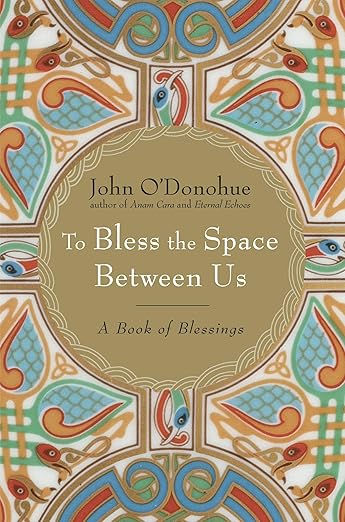
Though this is the book that brought John O’Donohue to my attention, it is not the first of his books I read. I started with Anam Ċara, O’Donohue’s manifesto on the duality of life, as seen through the lens of Celtic spiritualism. The book had a profound impact on me in ways I don’t think I’ve yet fully comprehended. It’s theological linguistics challenged the ardent atheist in me, even if that’s a term I haven’t used to describe myself since the aughts, while expanding the boundaries of the burgeoning animism that has sprung forth since my move to the tallgrass prairie five years ago.
To Bless the Space Between Us’s subtitle, A Book of Blessings, tells you everything you need to know. This is a book of blessings, for seemingly every situation—from martins to work to marriage to exhaustion to death—and, as such, isn’t best read all in one go—or read in a go at all. I chose to read one blessing a day over the course of three months or so, and, as might be expected, some blessings are more universal (e.g. “On Meeting a Stranger” or “In Praise of Water”) than others (e.g. “For the Parents of One Who Has Committed a Crime” or “For the Family and Friends of a Suicide”). But all of them are deep in their wisdom, in their comfort and care, in their ability to invoke hope, invite peace, and celebrate life, even in its darkest moments.
“There is a quiet light that shines in every heart,” O’Donohue opens his introduction. With that seemingly benign sentence, worlds upon worlds open up to those who would receive it. He continues, “It would be infinitely lonely to live in a world without blessing. The word blessing evokes a sense of warmth and protection, it suggests that no life is alone or unreachable. Each life is clothed in a raiment of spirit that secretly links it to everything else. Though suffering and chaos befall us, they can never quench the inner light of providence.” A blessing invites an interiority, a chance to more fully engage with the self, not to shun the outside world, but to find our way back to belonging. There can be no communion with others if we cannot commune with ourselves.
As Dr. Sharon says in Ted Lasso, “Self-care can be scary,” and a blessing, when removed from its religious trappings, feels like nothing more than a heaping dose of self-care, as Ted might put it, one many don’t think they deserve, or are fit to receive, or are free to offer. But O’Donohue submits that, “Wherever one person takes another into the care of their heart, they have the power to bless.” That is, so long as love is there, anyone can offer a blessing to another, anytime, anywhere, for any reason. But, he goes further, “Perhaps we bless one another all the time, without even realizing it. When we show compassion or kindness to another, we are setting blessing in train.” These days, compassion and kindness seem to be out of vogue, replaced with retribution and cruelty. That may be the world we see on TV or read about in the paper, because that world commands—demands—attention, but that is not the undercurrent of the world.
The real world is filled with blessings, and we are, each of us, though, sadly, pitifully, not all of us, giving and receiving them daily, even if we don’t realize it, or haven’t given them words, or fashioned them into poems. To Bless the Space Between Us is O’Donohue’s gift to the world, a gift that feels more necessary in 2026 than anyone could have imagined when it was published in 2008. Take these blessings to heart, give them as gifts to others, and learn to find the power to bless within yourself.


Comments