

How Are We to Live? Ethics in an Age of Self-Interest
Updated: Aug 8
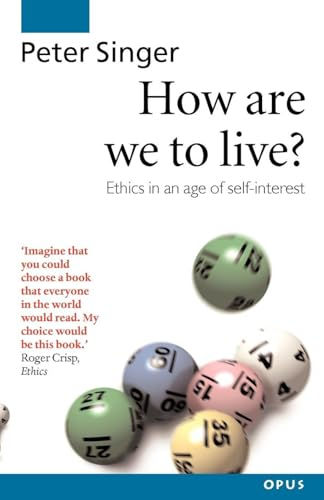
It’s quite possible Peter Singer has had a greater impact on my life than anyone else. When I was a senior in high school, I read Animal Liberation, his 1975 book in which he argued for a new ethics in our treatment of animals. That was 1991. I’ve been vegan ever since. In contrast, I grew up a child of divorced parents, both from conservative Catholic families. By the time I was a young adult, I found myself at odds with their view of the world. My mother voted for H. Ross Perot—twice. Her third husband, of nearly thirty years and a Fox News junkie, certainly voted for Donald J. Trump. My mother, if she was still alive, would have done the same, though she may have, but not necessarily, turned up her nose at some of Trump’s less savory qualities (I can imagine her excusing his famous off-camera denigration with a “Boys will be boys …”). My father, shocking though it still is to me, received for Christmas 2017 a framed picture of Donald and Melania Trump from Trump’s presidential inauguration. When my father tore open the wrapping paper to find what was inside, he exclaimed, “That’s my man!”
Where do you find a middle ground with that when you despise everything about Trump and what he represents? Later that trip, while out at a bar with two of my sisters, one of whom is a lesbian, in a final-nail-in-the-coffin move, I railed against Trump and the unfathomable discordance between her lifestyle and her politics. The result? At my third sister’s 2019 wedding, my brother reached out to shake my wife’s hand as if they hadn’t hugged a hundred times before, none of my immediate family said more than the barest of salutations (and most not even that), and at the reception, we were seated at the second-cousins table (Table 19 anyone?). Though I get the occasional text from my father and the obligatory holiday card, I am essentially persona non grata in my family.
All of which, I think, brings me back to the book at hand, Peter Singer’s How Are We to Live? Ethics in an Age of Self-Interest. Originally published in 1993 with a new edition and preface in 1997, it’s clearly written in the wake of the 1980s—the “Greed Decade”—when consumerism, conspicuous consumption, and self-interest were, up to then anyway, at an all-time high. (The irony that Trump was such a looming, iconic figure in those days vis-à-vis my family dynamics is not lost on me.) I was quite excited to finally get around to this book. One, to see if lightning would strike twice, and two, because if we thought the ’80s was the nadir for societal connectedness and reciprocity, just think what we’ve got now.
This isn’t a book about politics or religion, it’s a book about ethics. In our current world, however, our ethics are often conflated with either or both of those things. (You can ask yourself, “Did my ethics lead me to be/do ___________, or am I/do I ___________ because of my ethics?”) In a world where religion is no longer widely seen as a guide to life, this is a book about finding meaning and purpose, about finding something worth pursuing—beyond the self, beyond money, beyond success. No, lightning did not strike twice. How could it have? After all, I’ve been vegan for nearly two-thirds of my life, choosing a lifestyle that puts my compassion for nonhuman animals at the center of my very existence. And the moral principles that guide me don’t stop there, they lead me wherever I go, constantly placing me at odds—out of step, as Ian MacKaye once sang—with the world.
And the book itself? With its deft combination of philosophical argument and real-world examples, I can imagine a young adult, lost in a world of environmental collapse, polarizing politics, “binge-worthy” television, the paradox of social media, not to mention the Sturm und Drang of a global pandemic, picking up this book and finding hope. In a world that feels increasingly hopeless, with lives that seem increasingly meaningless, what more can you ask for? This is an important and highly readable book. Given the anxiety that is destroying young people today, if I could, I would get How Are We to Live? into the hands of everyone old enough to read it.


Comments