

Fear and Loathing: On the Campaign Trail ’72
Updated: Aug 8
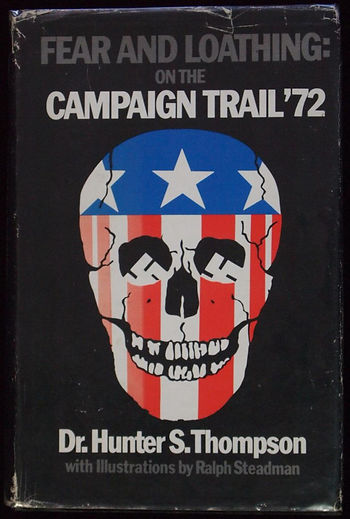
My rationale was this: If this year’s presidential election campaign was going to be chaos (and with Trump it’s always chaos; whether you relish or abhor it is another matter), why not follow Hunter S. Thompson as he documented another total pandemonium, the 1972 presidential campaign in which incumbent Nixon, running for a second term, finds himself up against a panoply of Democratic candidates (15 in all at the outset), including Hubert Humphrey and Edmund Muskie (who, as the Democratic ticket for president and vice-president respectively, lost to Nixon/Agnew in 1968), George Wallace (the “segregation now, segregation tomorrow, segregation forever” former and would-be-again Alabama governor), and George McGovern (three-term South Dakota senator and eventual nominee).
Derived from Rolling Stone magazine dispatches throughout 1972, Fear and Loathing: On the Campaign Trail ’72 finds Thompson embedded with the McGovern campaign (a lucky break as it turns out) as McGovern goes from dark horse candidate to Democratic party nominee to ignominious—and legendary—defeat. Nixon essentially did no campaigning, though anyone who’s read All the President’s Men, or seen the excellent movie based on it, knows what he was up to behind the scenes: ratfucking, including, but in no way limited to, Watergate. However, the Watergate break-in didn’t happen until June 1972, and most of what we associate with its investigation and aftermath, culminating in Nixon’s resignation, didn’t gain momentum until well after the November election.
So, we have a four-horse race with Nixon largely nowhere to be seen, and while Thompson deplores Nixon, aside from McGovern, he doesn’t find much worth in the rest of the lot: “Hubert Humphrey is a treacherous, gutless old ward-heeler who should be put in a goddamn bottle and sent out with the Japanese current.” And: “One of Muskie’s main problems, thus far, has been that not even his hired staff people really like him.” And: “The ugly truth is that Wallace had never even bothered to understand the problems—much less come up with any honest solutions.” As McGovern gains momentum during the primaries, driven by a strong grassroots campaign, the others fall by the wayside, though there is quite a lot of behind-the-scenes maneuvering vis-à-vis his former opponents before and during the Democratic convention to ensure McGovern wins the nomination on the first ballot.
In true Gonzo journalism fashion, we get it all: the digressions, the tangents, the flashbacks, the nonsequiturs, and, of course, instances where Thompson had to go “full Gonzo” by transcribing unedited notes, dictating into a tape recorder to be transcribed by others, and being interviewed by the editor—all to get the story in on time. If there’s a fault with the book, it’s not Thompson’s: Politics, politicians and their handlers, and political races can be mind-numbingly boring at times. And, despite whatever reputation might precede him, Thompson is a keen observer and thoughtful writer. His refreshingly honest reporting about the whole mess, even if he is prone to the occasional exaggeration, would have been a gift to the masses who weren’t tuned into Rolling Stone.
But in 1972, as in 2024, the masses didn’t want all that jazz. As Thompson writes near the end, “The tragedy of all this is that George McGovern, for all his mistakes and all his imprecise talk about ‘new politics’ and ‘honesty in government,’ is one of the few men who’ve run for President of the United States in this century who really understands what a fantastic monument to all the best instincts of the human race this country might have been, if we could have kept it out of the hands of greedy little hustlers like Richard Nixon.”
We are only days removed from the 2024 election, and while the post-mortems are still underway and truly thoughtful analyses about what happened have yet to land, what is clear is that the people chose someone they believed would restore order to a world that seems to be spiraling out of control—much as with Nixon. Whether Trump, sower of chaos, can restore anything besides himself into power, and whether what he restores will benefit the few or the many, remains to be seen.
As McGovern did, Harris may have campaigned on too little, but there was little doubt about who she was or what she stood for. Despite this, the American people still chose Trump. And as I wrote on Instagram on Election Day, in a post that accompanied Thompson’s “tragedy” quote above, “Sometimes one has to hit bottom before one can rise again. Over the next four years, we’re going to see just how low we will go. I don’t care who or what you do or don’t pray to—one God, a panoply of gods, nature, the Flying Spaghetti Monster, or nothing at all—but god bless us all for what we’ve just gotten ourselves into. We will need each other more than ever.”


Comments