

American Theocracy: The Peril and Politics of Radical Religion, Oil and Borrowed Money in the 21st Century
Updated: Aug 8
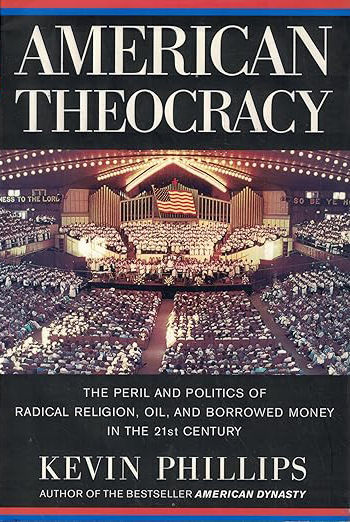
I chose to read Kevin Phillips’s American Theocracy: The Peril and Politics of Radical Religion, Oil and Borrowed Money in the 21st Century at the worst possible time. We were in the middle of buying a new house, selling the old one, packing, moving, unpacking, and doing our best to settle in and establish our old routines in a completely different setting. I’d checked the book out of our old town’s library, returned it two-thirds finished the day the movers showed up, then reserved it from our new town’s library the next day.
Given all that, seven weeks seems a pretty reasonable length of time to finish the book, but that’s only part of the reason it took so long. The other (and this one I can’t be blamed for) is that American Theocracy is a grind of a read. Kevin Phillips is clearly intelligent, and his sincerity in exploring, as he sees it, the unfortunate drift of his Republican party towards a fundamentalist Christian worldview while rejecting science, rationalism, and, what was once their stock-in-trade, fiscal responsibility, is obvious.
Three problems handcuff this book, though the first isn’t Phillips’s fault. The first is that the book was published in 2006 (at the nadir of George W. Bush’s presidency, who is almost certainly the most evangelical leader this country has ever had) and many of the book's hypotheses about what dire turns of events we might expect to see in the 2010s have not come to pass. (It is entirely my fault that I continue to read outdated current-events nonfiction.) The second is that Phillips simply isn’t a very good writer. His style is stiff and academic, and if this is how his other books are written, I suspect his audience—though it could, and should, be much larger—is made up of scholars and think-tank wonks who write similarly dry material. Finally, despite an abundance of data, each piece of which feels compelling and damning in its own right, Phillips largely leaves it to the reader to tie the separate strands of his book together.
Yes, radical religion (Christian or otherwise) is dangerous to democracy. Yes, our dependence on oil, and lack of serious progress at scale on viable alternatives, is worrisome. And, yes, large-scale public and private debt, if continued unabated, is potentially catastrophic. These don’t seem like novel ideas, even back in 2006. Nor does the idea that policy driven by people with a biblical worldview, especially those who believe in the rapture and see signs of its imminence in global events, would result in their further deterioration. But correlation does not necessarily mean causation, and, if it does in this case, spending 394 pages to come to the conclusion that radical religion is bad for America, and the world, seems like overkill.
Despite the title, Phillips isn’t really suggesting that America is becoming a theocracy but that his political party of choice is. A better, less misleading title would have been Republican Theocracy, but that, no doubt, would have reduced the book’s already narrow audience further still. In the end, for this liberal who is always looking for intelligent perspectives that don’t simply echo my worldview, the bigger disappointment is that Phillips isn’t a better writer. I appreciate the thought-provoking material he provides, but can’t abide the castor-oil delivery.


Comments